

Just 15 minutes south of Astoria, Fort Clatsop is one of the most unique parks near the Oregon Coast. Set within a coastal forest of towering Sitka spruce, the fort is where Lewis, Clark, and the Corps of Discovery spent the winter at the end of the Oregon Trail. Part history lesson and part nature excursion, Fort Clatsop serves as a trailhead for miles of hiking trails. The longest of them, the Fort to Sea Trail, ends at the ocean. Here’s everything you need to know about visiting Fort Clatsop.

Fort Clatsop courtyard
Know before you go
Cost: Theentrance fee to enter the Fort Clatsop Visitor Center and see the fort is $10 per adult. Admission is valid for 7 days. You can use the America the Beautiful pass to waive admission for yourself and up to 3 other people. The Annual Oregon Pacific Coast Passport will waive admission for one person. Children 15 and under can visit Fort Clatsop for free.
Parking: The parking lot outside the Visitor Center does not require a pass or permit. I’ve never had a problem getting a spot.
Minimal walking (several hundred yards) is needed to reach Fort Clatsop from the Visitor Center. There are hiking trails nearby if you are looking for more activity. See below.
Dogs: Leashed dogs are allowed in the outdoor areas of Fort Clatsop, including the trails and courtyard of the fort. Only service animals are allowed inside the Visitor Center and the interior rooms of the fort.
Restrooms are in the Visitor Center.

Inside a room at Fort Clatsop
Things to do at Fort Clatsop
Tour the Fort Clatsop Visitor Center. The museum area has information about life at Fort Clatsop and the Oregon Trail.
Browse the bookstore and gift shop.
Watch movies in the Visitor Center theater. They play every hour and delve into the history of the fort as well as the native peoples of the area.
Tour the replica of Fort Clatsop.
Hike on the trails.
Learn to identify plants of the coastal Pacific Northwest. Signs in the forest around Fort Clatsop label the major plants there, including Sitka spruce, hemlock, Oregon grape, and huckleberry bushes.
Watch for wildlife like Roosevelt elk, bald eagles, osprey, hawks, herons, frogs, and salamanders.
Have a picnic in the woods.
History of Fort Clatsop
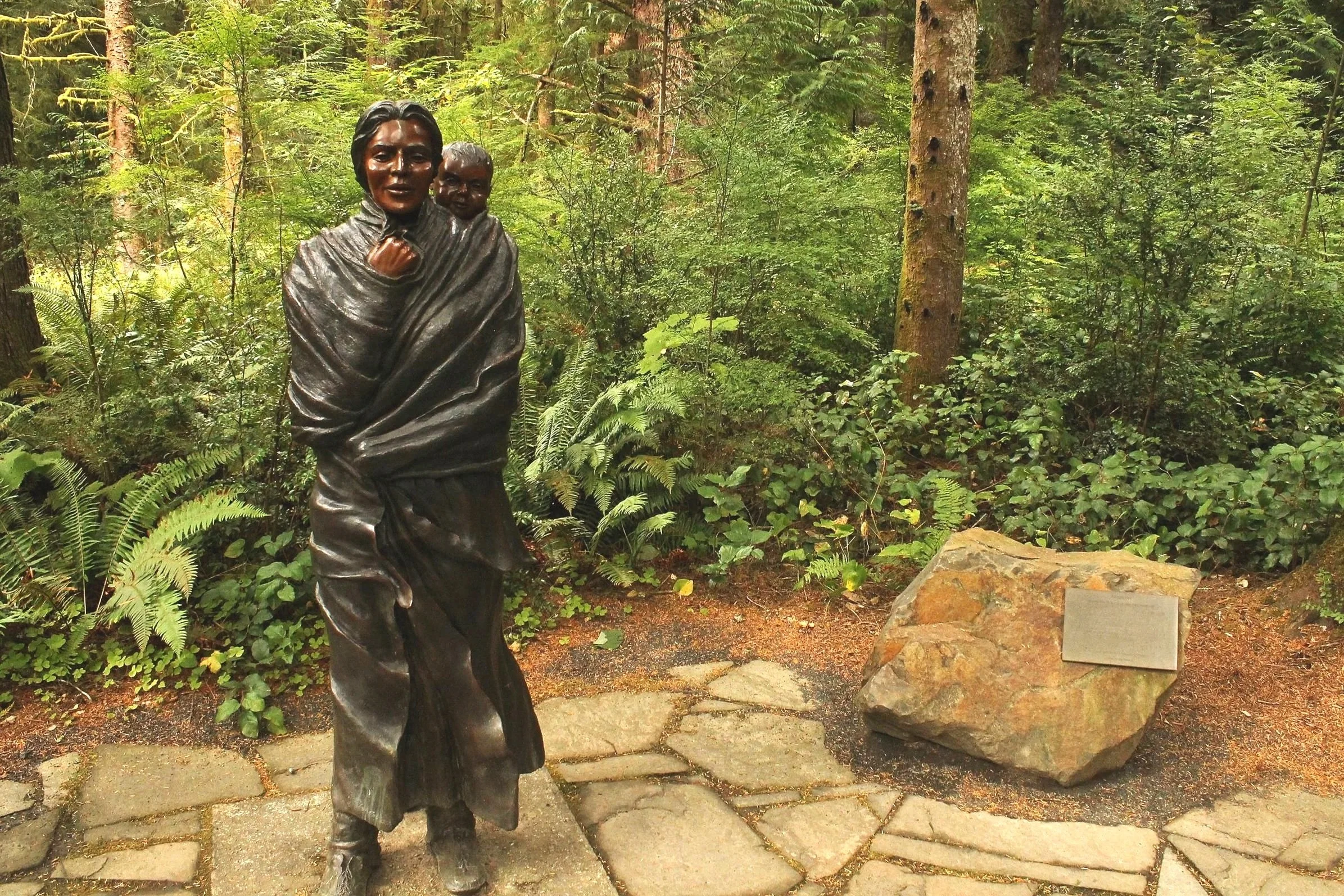
Bronze statue of Sacagawea
The Corps of Discovery, led by Meriwether Lewis and William Clark, built the original Fort Clatsop in December of 1805 as a winter shelter at the end of the Oregon Trail. For several months, the fort housed 34 people, including the Corps’s Shoshone interpreter, Sacagawea, and her infant son.
The Corps remained at Fort Clatsop until March of 1806, when they began their return journey east. The original fort has long since been lost to mildew and decay over the years. The hewn log fort that stands there today is a skilled replica, built in 2006 based on a sketch by William Clark.
The displays and exhibits at Fort Clatsop provide a lot of rich detail about what life was like there. The overwhelming impression is that it was pretty miserable. It rained nearly every day. Members of the Corps would have spent most of their time inside the cramped and dimly lit rooms of the fort. Illnesses were common and spread easily. Food was scarce and relied heavily on what the Corps could procure by hunting.
Despite the drawbacks, Fort Clatsop also had some advantages that made it a good choice for a winter shelter. It was close to the ocean and its critical supply of salt while still being protected from storms. There was plenty of fresh water and game to hunt. The Corps also benefited from trade with the Clatsop and Chinook tribes, which helped them procure supplies they needed to make it through the winter.
Hiking trails near Fort Clatsop

Bridge over the Lewis and Clark River
Netul River Trail is a flat, easy 2.4-mile out-and-back stroll from Fort Clatsop along the Lewis and Clark River out to Netul Landing. It begins in a dense forest of Sitka spruce and hemlock and includes a boardwalk overlooking the river. Continue through a tranquil forest of red alder until you reach Netul Landing. There’s more interpretive information about the Oregon Trail and picnic tables at the landing. Look for birds like mallards, herons, and egrets in the water along the way.
The South Clatsop Slough Loop is a 3.2-mile trail that includes most of the Netul River Trail but also has a branch to the west that makes the hike into a loop and adds more wetland habitat along the way. It’s a great hike for birdwatching.
Fort Clatsop begins the Fort-to-Sea Trail, a 13-mile out-and-back trail that winds through coastal forests until its ending point at Sunset Beach. Although long, there is little elevation gain, and the trail is fairly easy throughout. Rather than heading back the way you came, you can take the Kwis Kwis Trail, which runs parallel to the Fort-to-Sea Trail.
Beaches near Fort Clatsop

Sunset Beach
I know you wouldn’t drive all the way to Fort Clatsop without stopping to see the Pacific Ocean. Several beaches nearby are easy stops on your way to or from Portland.
Sunset Beach at the end of the Fort-to-Sea trail is a long sandy beach bordered by grassy dunes. On a clear day, you can see Tillamook Head to the south and Cape Disappointment to the north.
Gearhart Beach, to the south of Sunset Beach, is another sandy beach that tends not to get very crowded. There’s a small market in town as well as a McMenamins restaurant and bar overlooking the golf course (alas, not the ocean). The neighborhoods there are great places to look for Roosevelt elk.
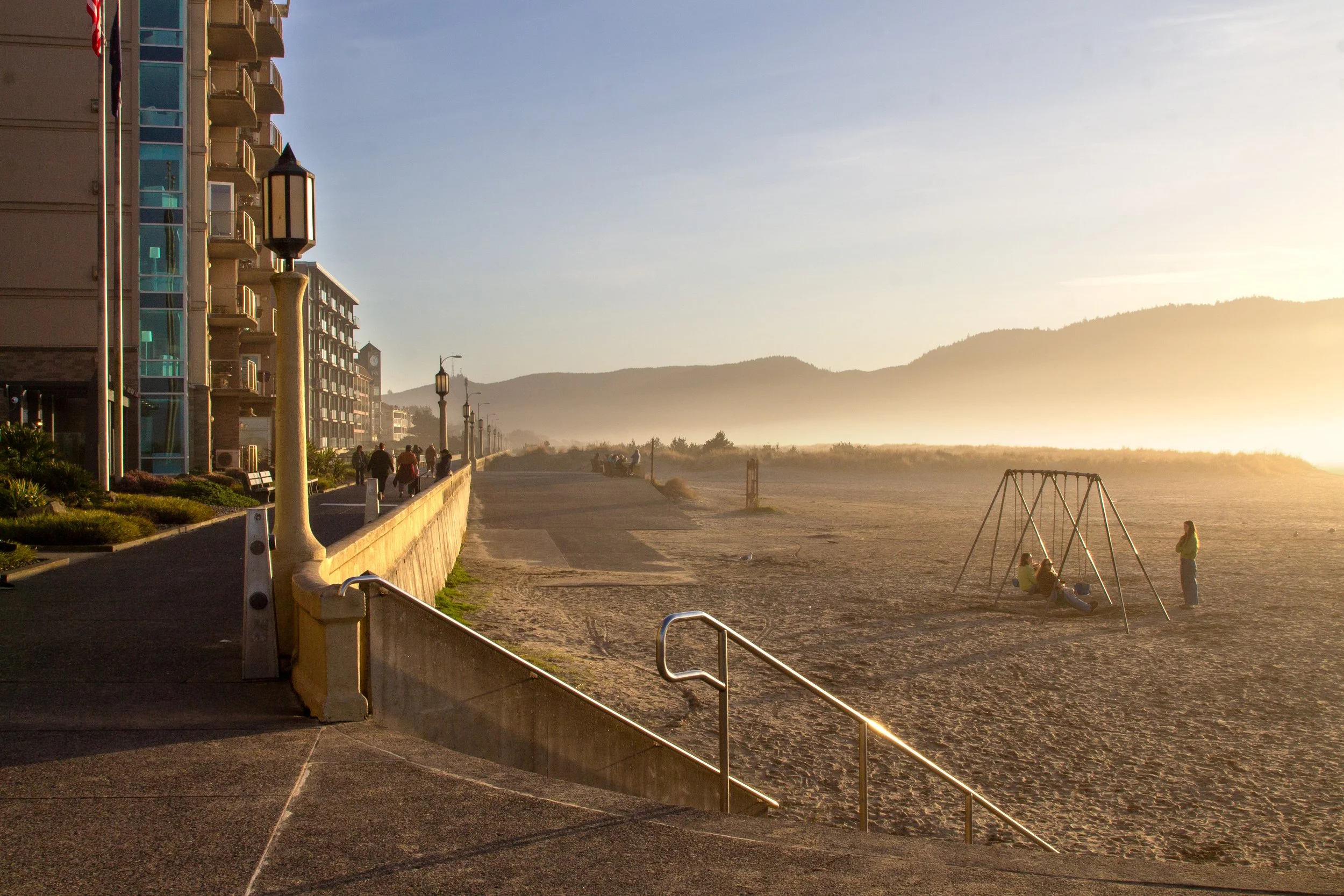
Seaside is a classic beach town with a promenade along the dunes and many access points along the way to reach the ocean. It’s much more developed than the other two beaches on this list and has the most dining and lodging options. It has plenty of silliness to explore there, like arcades, ice cream shops, candy stores, and giant swan-shaped paddle boats.
Getting there
To reach Fort Clatsop from Portland, take Highway 26 West until Highway 101. Continue on Highway 101 North for about 15 miles, then turn right onto Ensign Lane. After about 2 miles, turn right onto Fort Clatsop Road and follow signs for the parking lot. The drive will take about 2 hours.
Enjoy your trip to Fort Clatsop and the Oregon Coast!
With love,
Emma
Explore nearby

Visit the Astoria Column.
Spend the perfect day in Seaside, Oregon.

Find more Pacific Northwest history at Cape Disappointment State Park.