
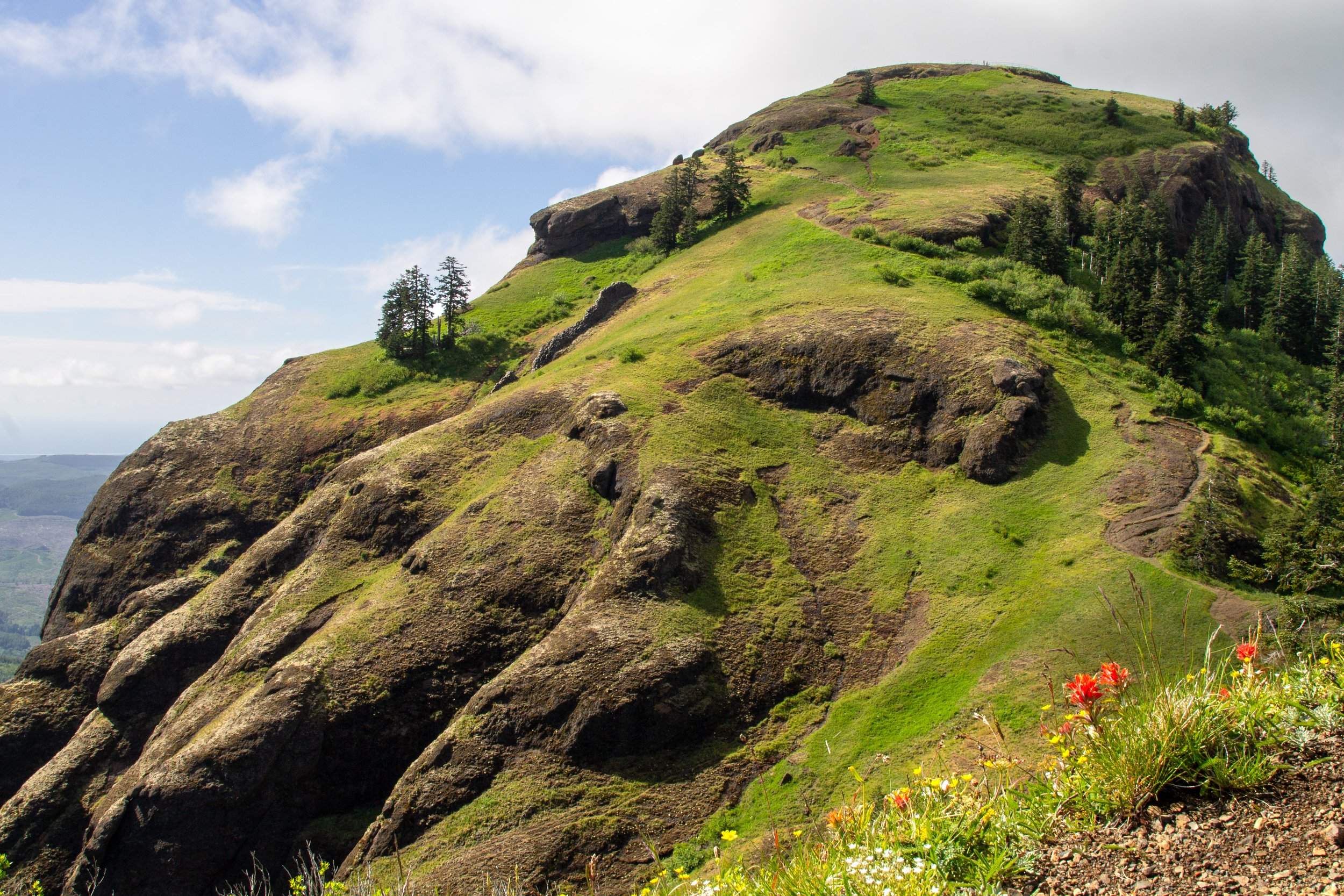
The Saddle Mountain Trail brings you to mega views. Sometimes. The hike ends at Saddle Mountain’s 3,267-foot summit, the highest point in northwest Oregon. The changeable weather makes the scenery a bit of a roulette wheel. When the skies are clear, you’ll be able to see from the Cascade Mountains to the Pacific Ocean. When fog rolls in, it can be hard to see your hand in front of you. In early summer, wildflower-covered slopes and rare plants help keep your mind off your weary legs and inaccurate weather forecasts. Here’s how to hike up Saddle Mountain.
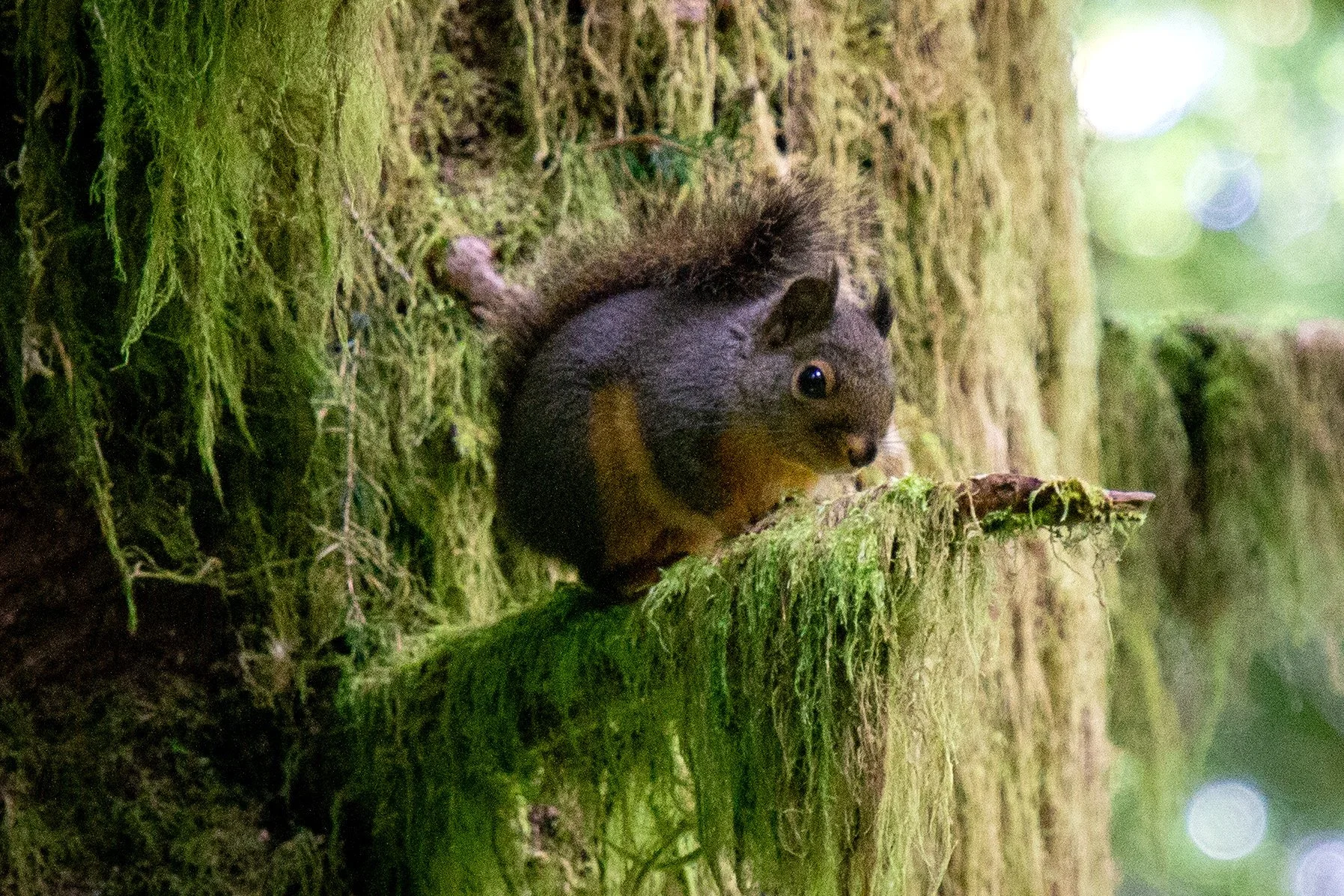
Douglas squirrel on Saddle Mountain Trail
Quick stats
Distance: 5.2 miles out and back
Elevation gain: 1,900 feet
Difficulty: Hard
Pass required: None
ADA access: No
Know before you go
Cost: It’s free to hike at Saddle Mountain State Natural Area.
Parking: The Saddle Mountain Trail is popular. Arrive early on summer weekends. The road to the trailhead is paved. It has more than a few potholes, but you can make it in a low-clearance vehicle.
Amenities: Vault toilets and a picnic area are by the parking lot.
Dog-friendly: Leashed dogs are welcome on the trail. If you’re hiking with your dog, I’d recommend turning around when you reach the metal grating on the trail, starting about halfway up. It has sharp pieces that could hurt paws.
Hazards: The trail gets close to some drop-offs that are easy to avoid. Between the steepness and the cliffs, it’s not a great hike with younger kids.
Leave no trace: Rare plants grow on Saddle Mountain. Please stay on the trail. Don’t pick or step on the wildflowers.
Season: Spring through fall.
What to bring: Hiking boots (not sneakers), layers, sunscreen, lots of water, and snacks.
Saddle Mountain wildflowers
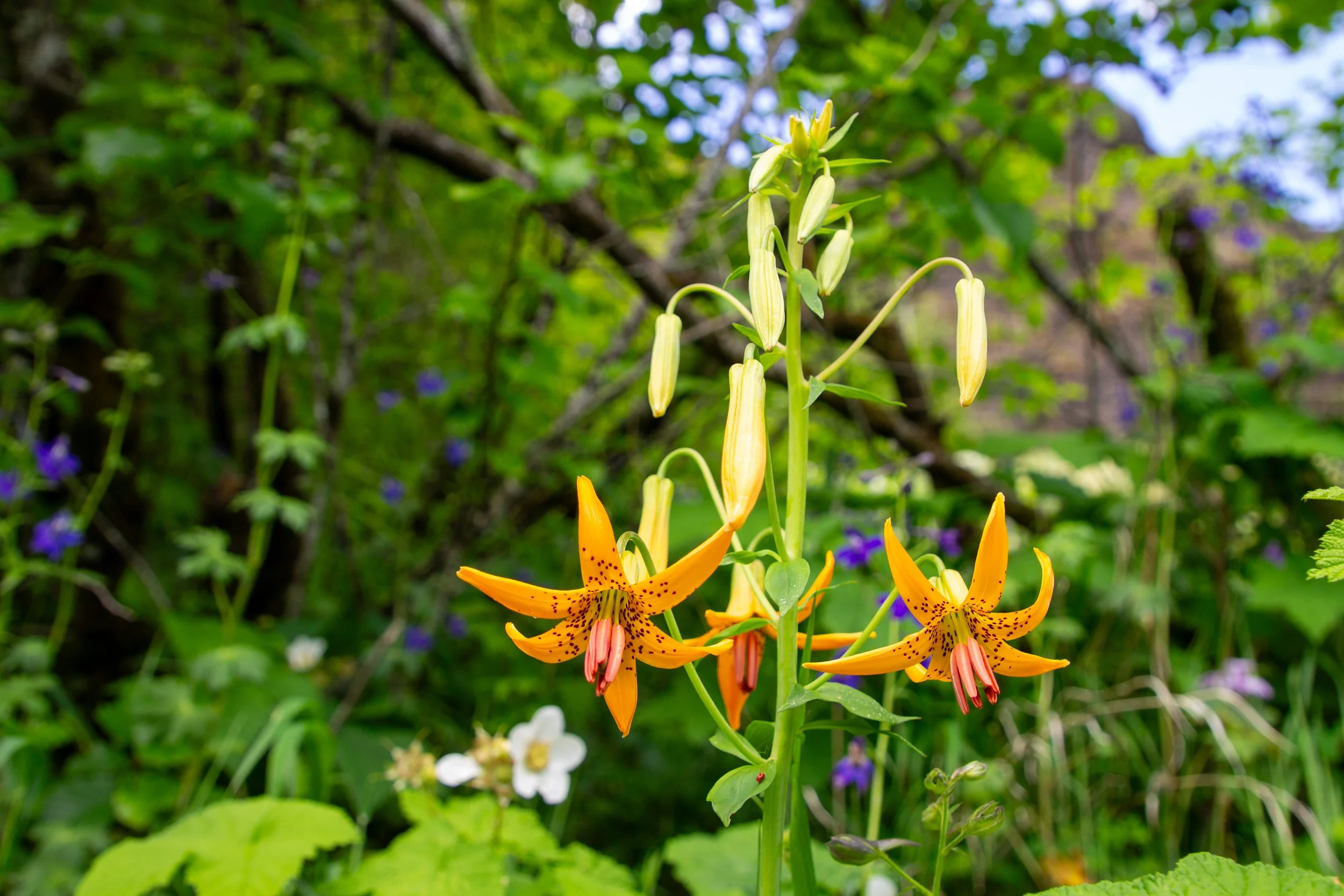
Tiger lily on Saddle Mountain
Wildflowers bloom on Saddle Mountain in late spring and early summer. June is a great time to see them. The earliest blooms usually appear around the end of April. The latest ones can last into early August. I counted about two dozen wildflower varieties on my early June visit. Irises were a standout. Other notables were paintbrush, monkeyflower, columbine, larkspur, tiger lilies, chocolate lilies, phlox, and Pacific starflower. Summer is also a good time to look for butterflies and hummingbirds cruising among the flowers. Saddle Mountain is home to rare species, including wildflowers, mosses, lichens, Cope's giant salamander, and the Oregon silverspot butterfly.
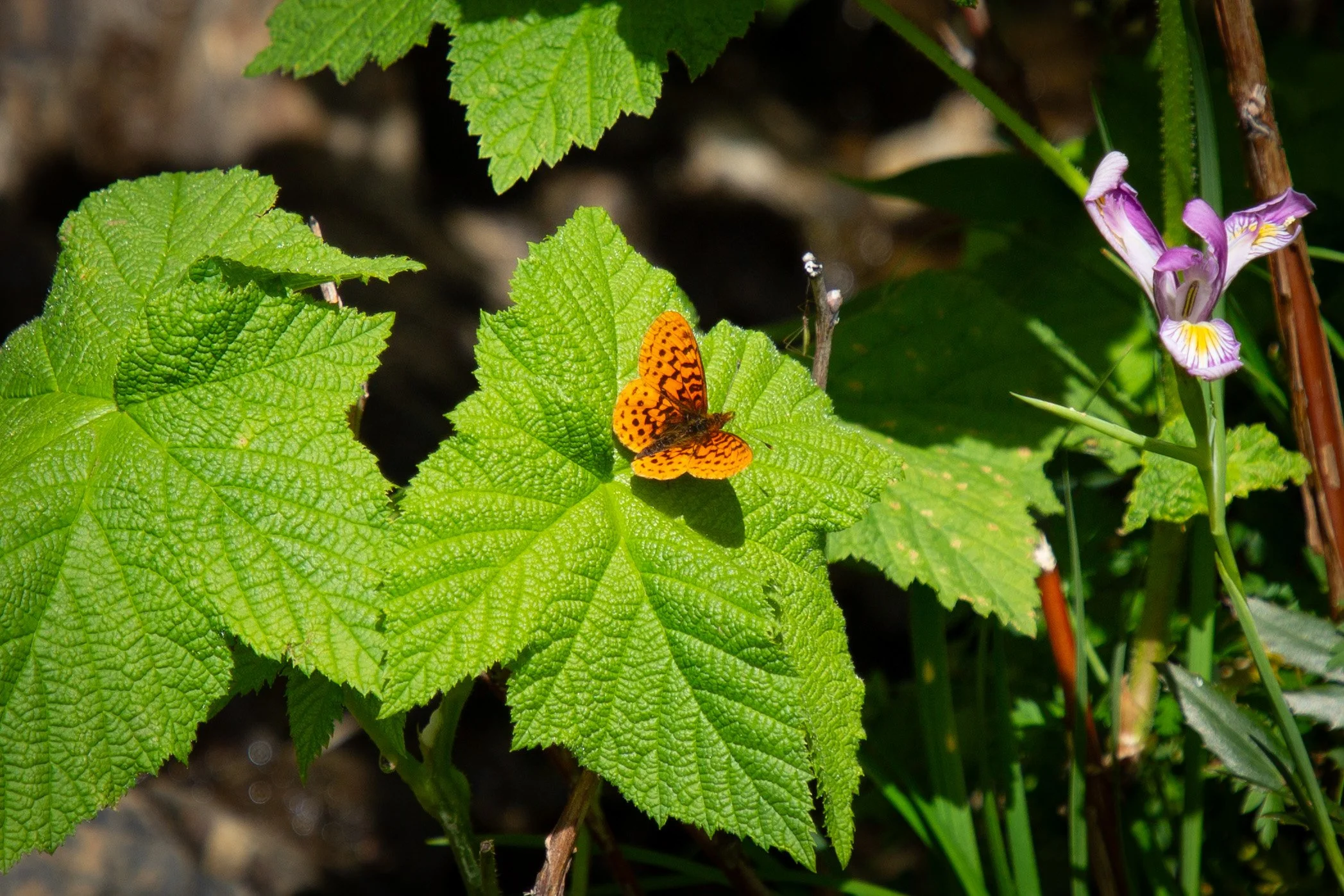
Expect wildflowers and butterflies on Saddle Mountain in summer
Saddle Mountain Trail
From the parking lot, the Saddle Mountain Trail starts where you see all the signs. One warns of rugged conditions suitable only for experienced hikers. While there’s nothing technical about this hike, you’ll want to come prepared with hiking boots and plenty of water. As you ration your energy, keep in mind that the hardest part of the hike is the last quarter mile.
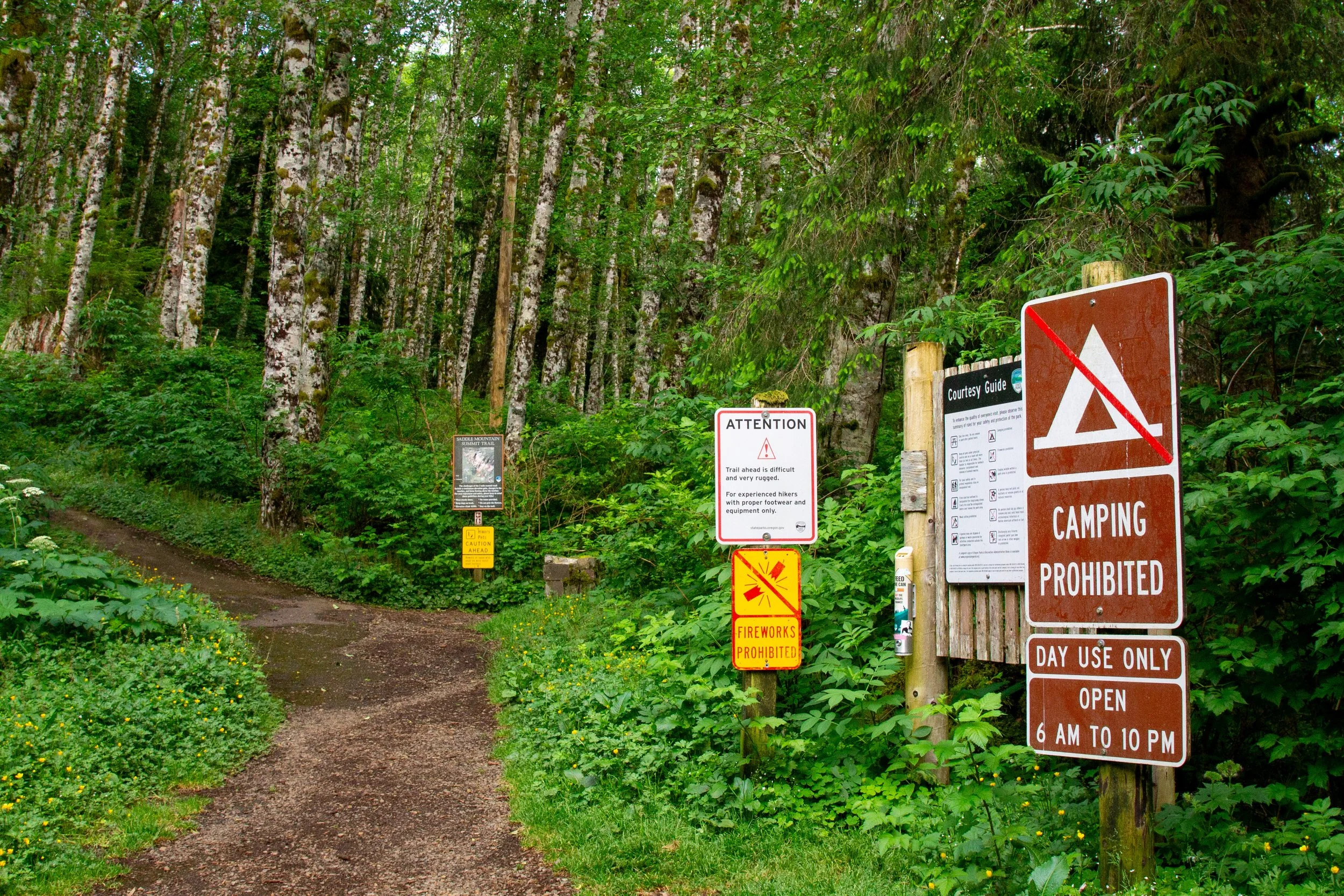
Start here
The first 100 feet or so of the trail is paved before it switches to a natural surface. The hike begins through an alder forest where salmonberries ripen in summer. Although a lovely mature forest, it’s not especially old. Logging and wildfires impacted the area in the 1920s and 30s. After about 0.2 miles, you’ll reach a trail junction. The trail to the right is an optional 0.2-mile spur to Humbug Mountain viewpoint. I’d say it’s worth the short detour. The views are a nice preview of things to come.
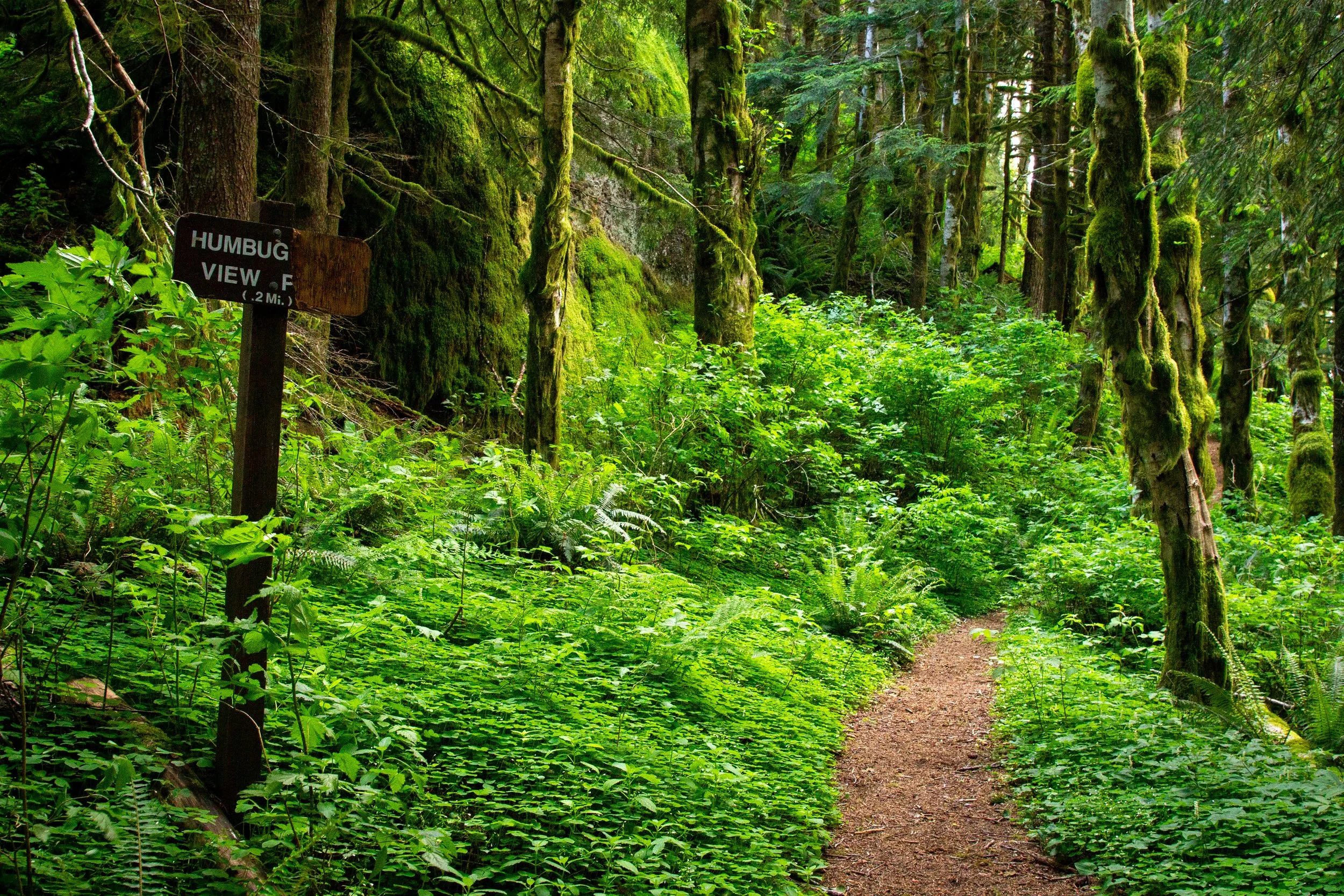
Humbug Mountain viewpoint spur
The short but rugged spur ends with a rock scramble to a viewpoint overlooking the Coast Range. The scenery is impressive, if bittersweet, a patchwork quilt of logging throughout the decades.
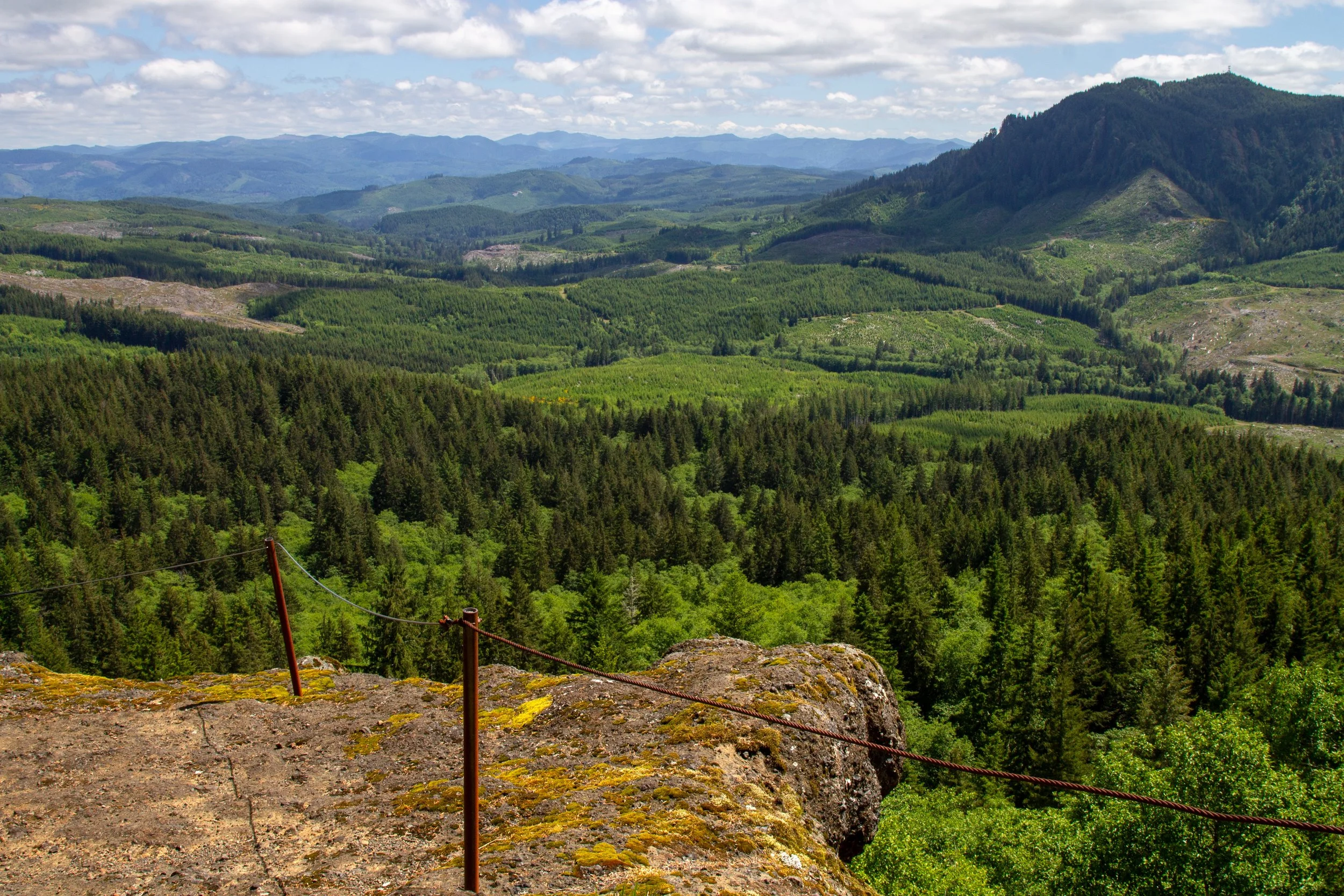
Humbug Mountain viewpoint
The viewpoint has a picnic table for a snack break. Behind it, you see Saddle Mountain looming. If you stop here on the way down, you can congratulate yourself on having made it back from the summit. Otherwise, best not to think too much about how high up and far away it looks.
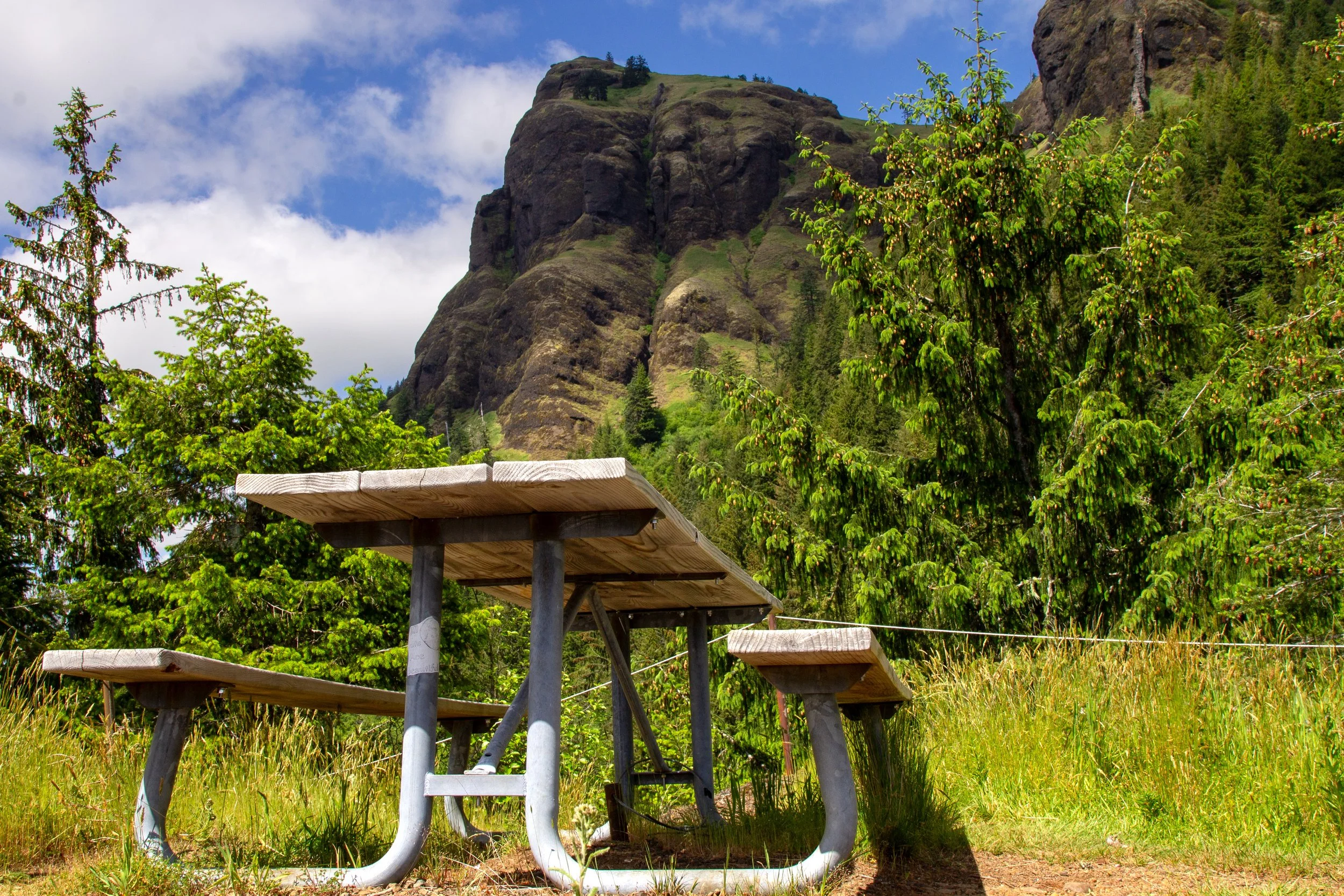
Humbug Mountain viewpoint
After returning from the spur trail, take a right at the junction to continue up Saddle Mountain. Sitka spruce, hemlock, and Doug fir have joined the alders. The ground cover is wood sorrel and false lily of the valley, which soon turns to a brambly mix.
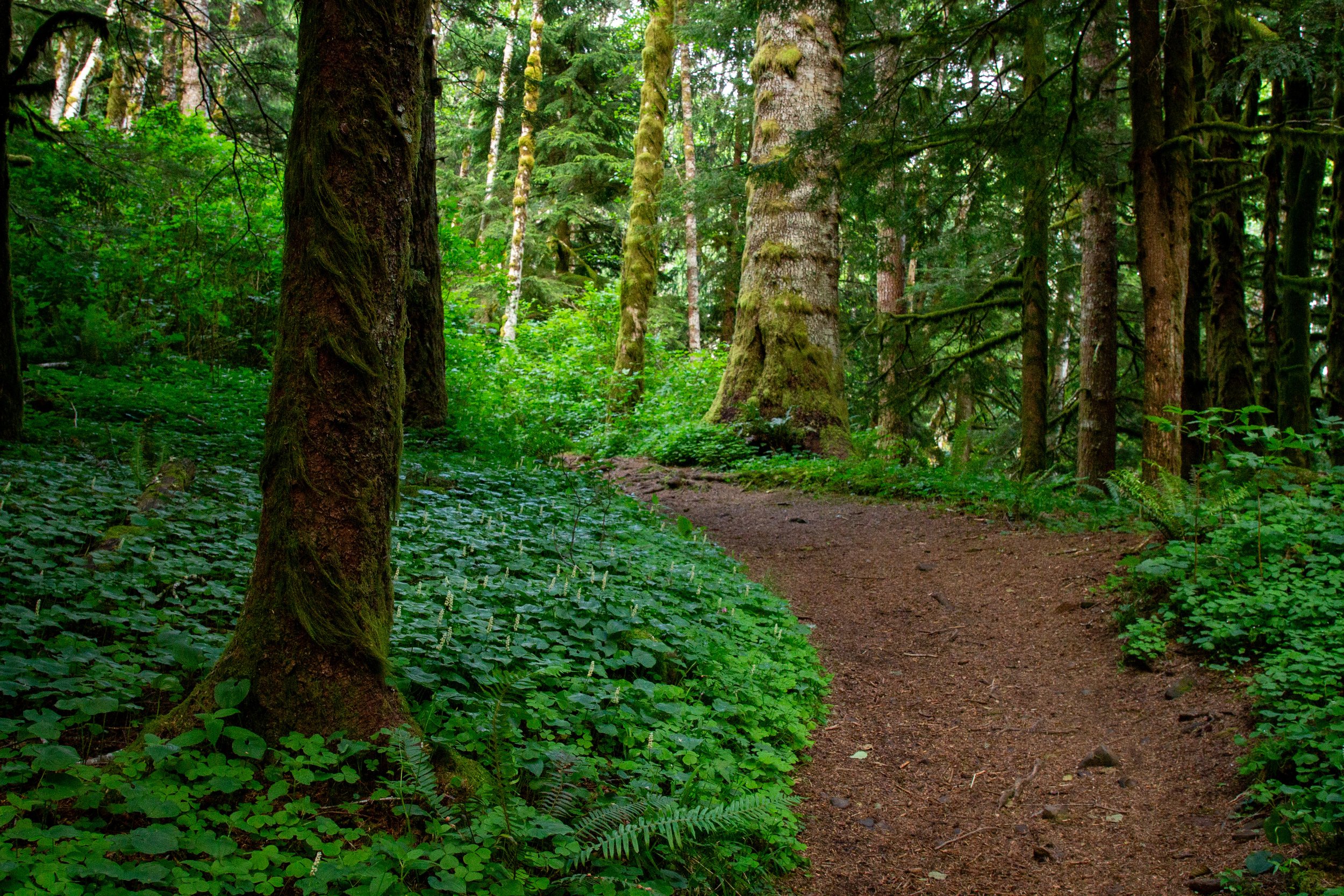
Saddle Mountain Trail
The Saddle Mountain Trail is in good condition, if overgrown at times. Thimbleberry bushes, cow parsnip, and larkspur encroach on the path. The hike heads steadily uphill. It doesn’t become very steep until the end. You’ll see a few mile markers as you make your way up switchbacks. The first of two improbable picnic tables next to the trail is a little after the first mile.
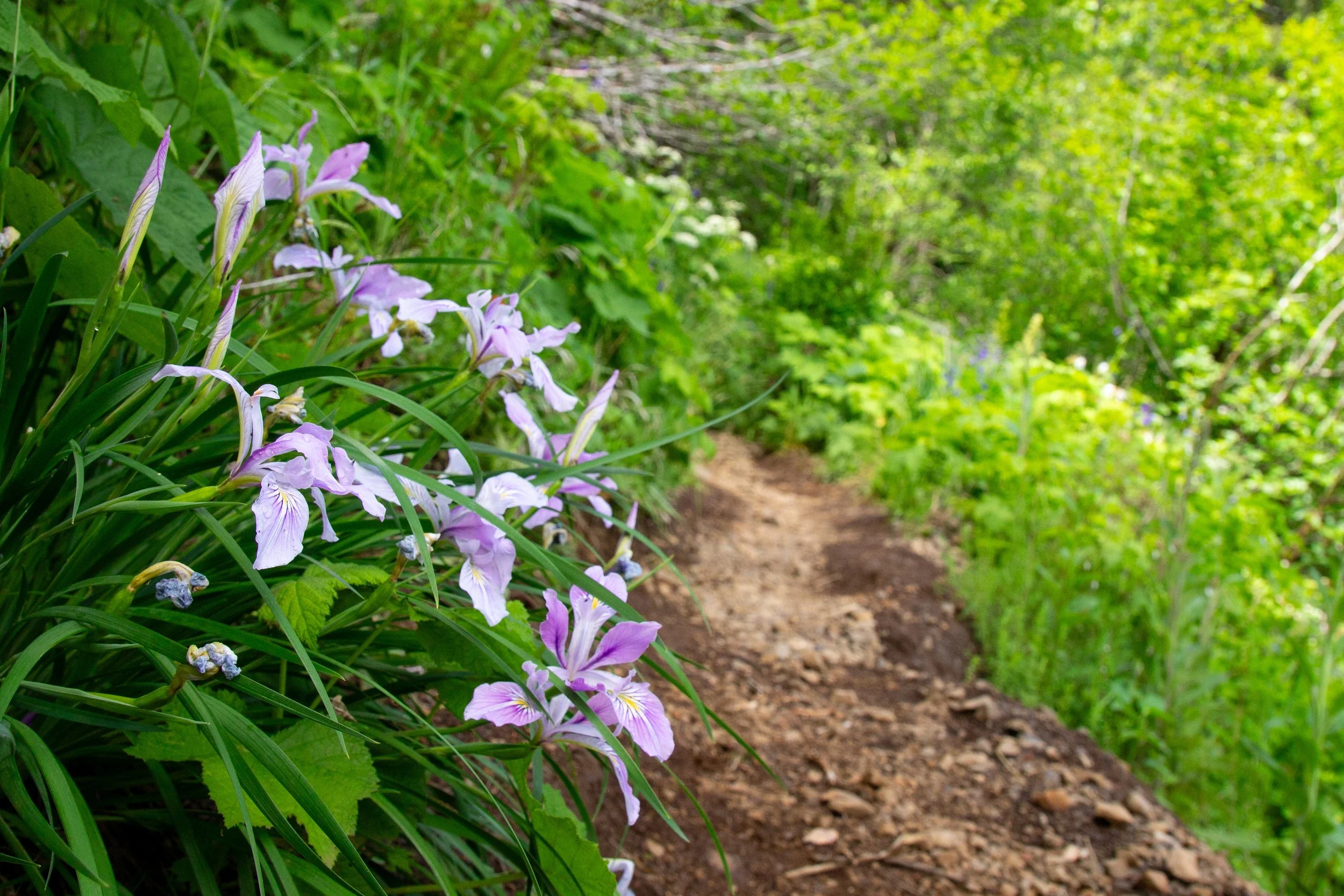
Irises on the Saddle Mountain Trail
Around the halfway point, the tree cover becomes patchier, opening up frequent views of the Coast Range and wildflower meadows. When you reach the first of the metal grating covering the trail, it’s a good turnaround point if you have a dog. The grating is like walking on a chainlink fence on its side, with plenty of rusty, broken ends sticking out. It does help with traction, especially on the way down from the summit.
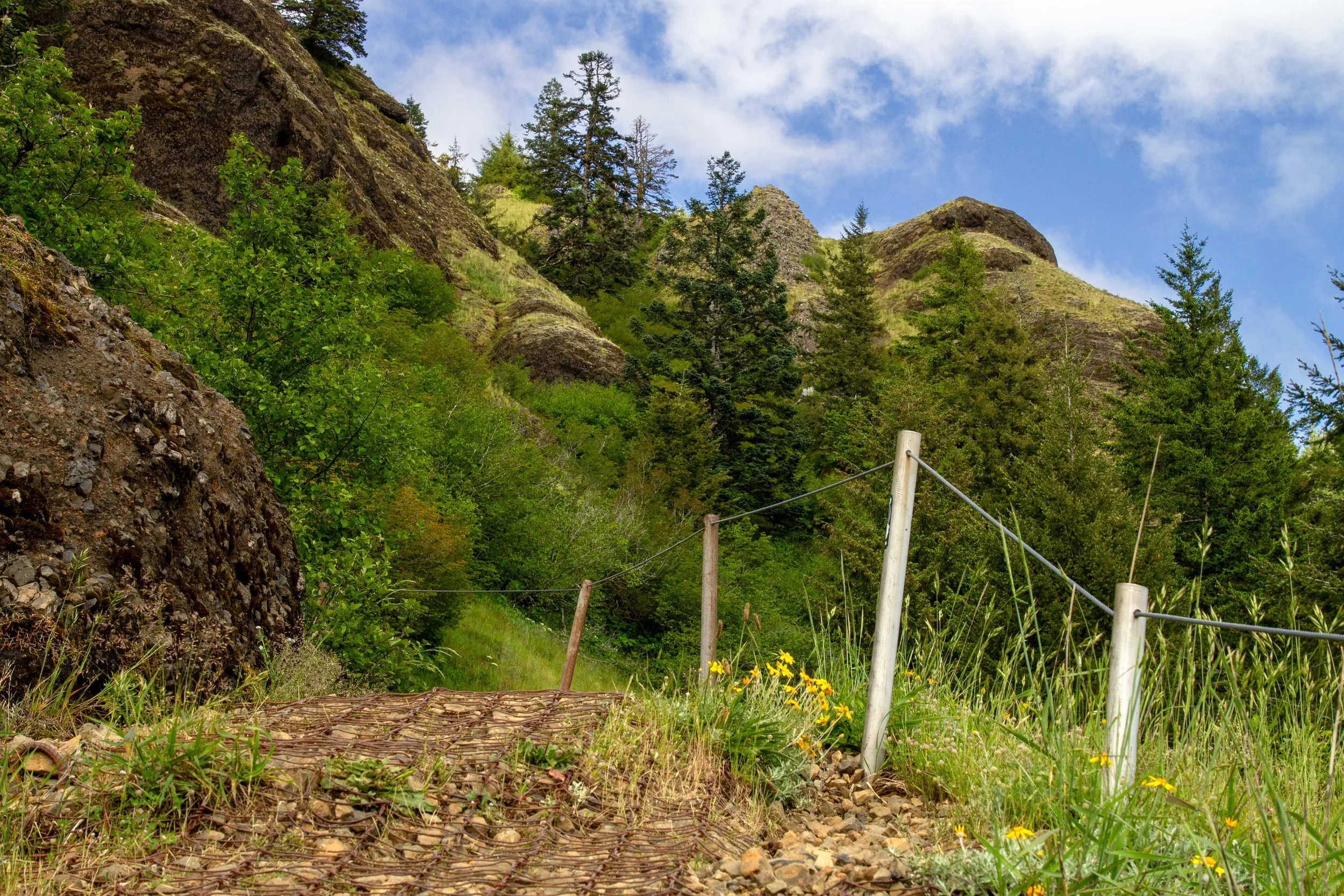
Saddle Mountain Trail
Saddle Mountain’s geology is easiest to appreciate once you get above the trees. The rock is basalt that formed around 14.5 million years ago, when lava flows from northeastern Oregon reached what was then the Pacific coastline. The collision of lava and ocean water caused rapid and explosive cooling, creating the breccia you see on Saddle Mountain. Meanwhile, still-molten parts of the lava flow formed dikes within the breccia. The fragmented basalt breaks off in irregular chunks, leaving behind unusual contours. An example is the strange pinnacle topped with a little knob you pass on the trail.
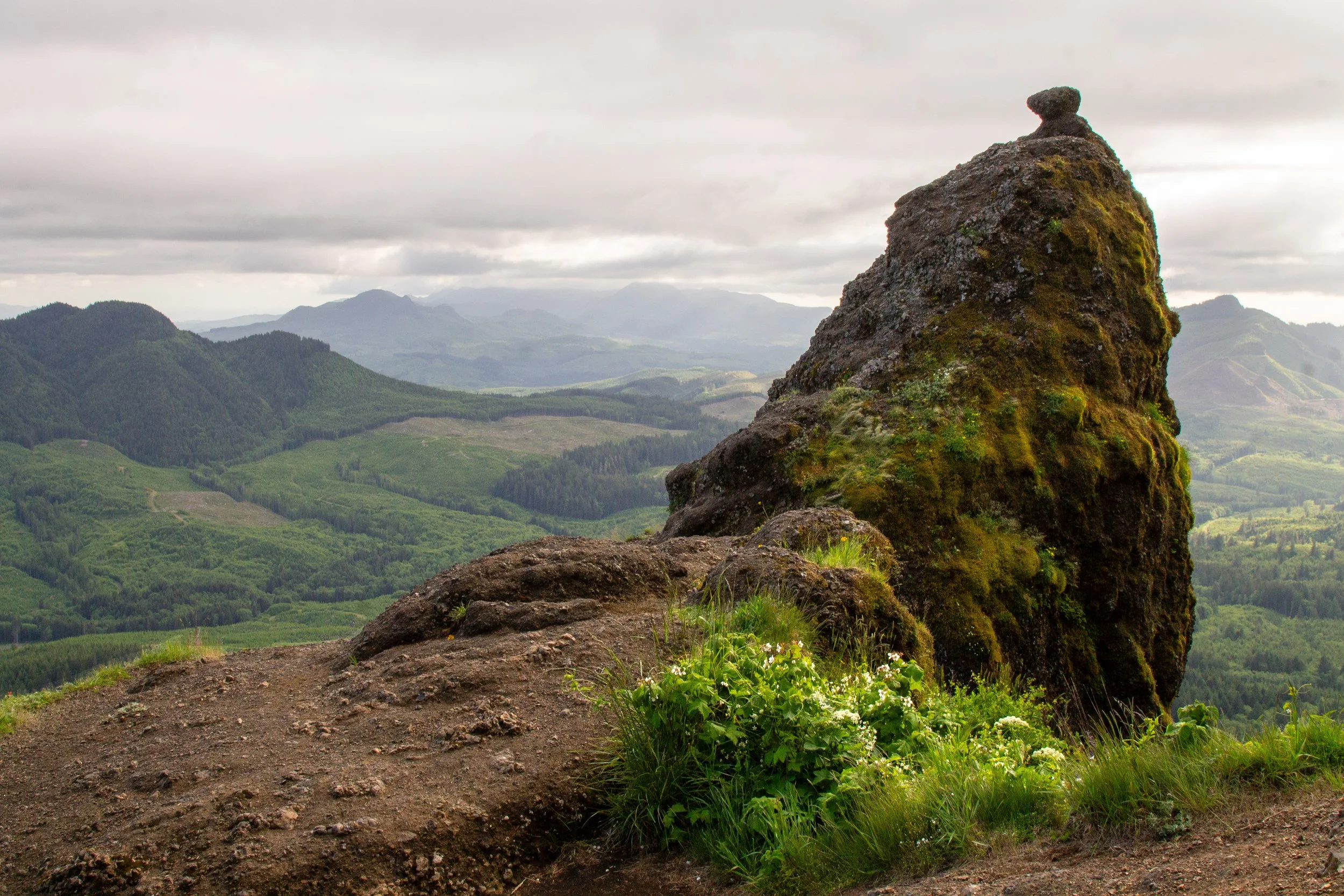
Trailside pinnacle
As you complete the Journey of the Many Panting Breaks (I’m hoping the name will catch on), wildflowers make a great distraction. They’re the main reason I’d recommend doing this hike in early to mid-summer. It helps to think about something besides the grade of the hill. Paintbrush and irises are highlights, but you’ll spot many other species on Saddle Mountain: checkermallow, larkspur, columbine, false Solomon seal, western bistort, fairy bells. Later in the season, thimbleberries would be a good consolation for the faded blooms.
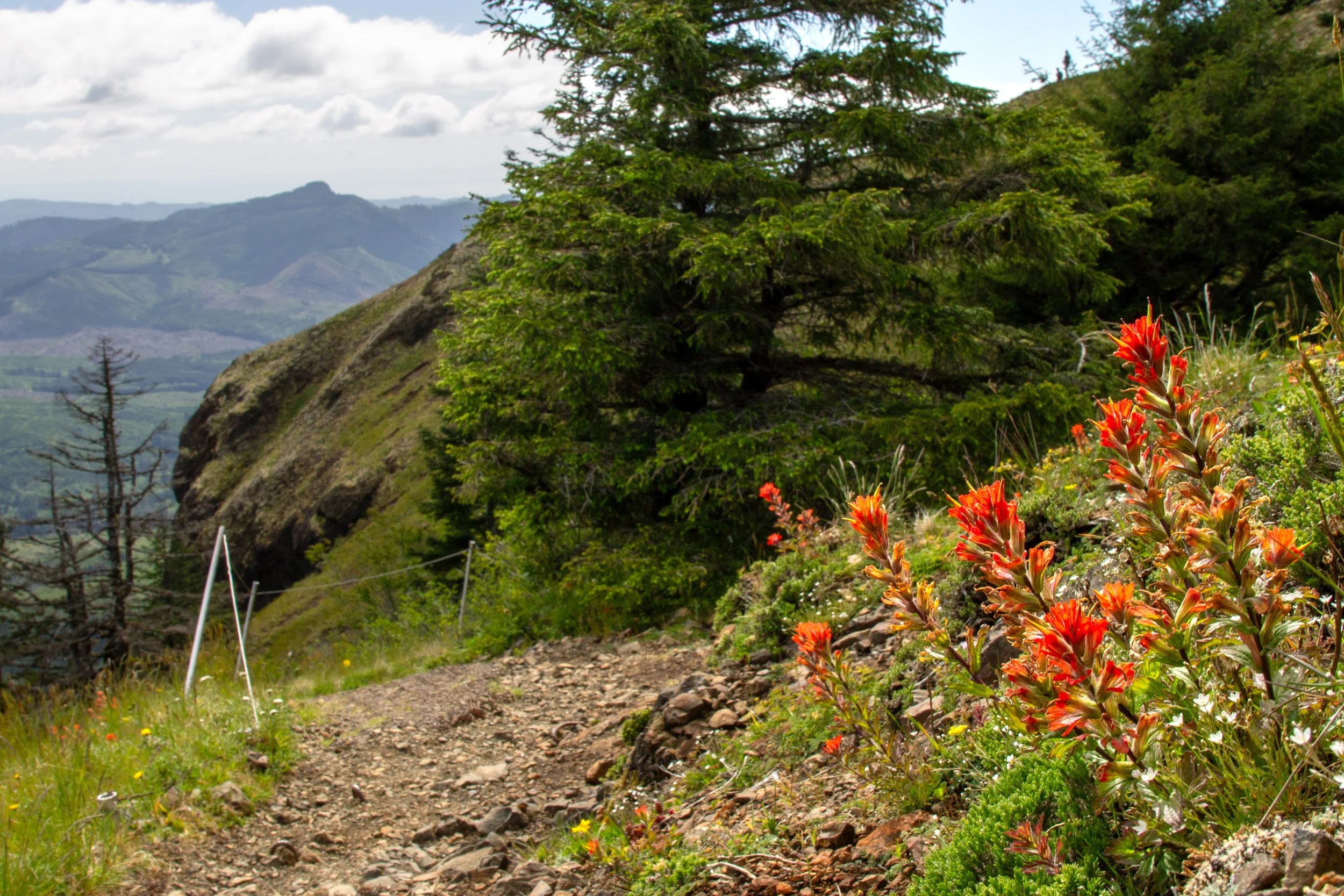
Paintbrush on Saddle Mountain
After two miles, you’ll reach an outcropping. Walking partway to the end, before it gets narrow and sketchy, brings you to the first view of the Pacific Ocean. Towering in front of it, you’ll see the end of the trail as it makes the somewhat daunting final ascent up Saddle Mountain.
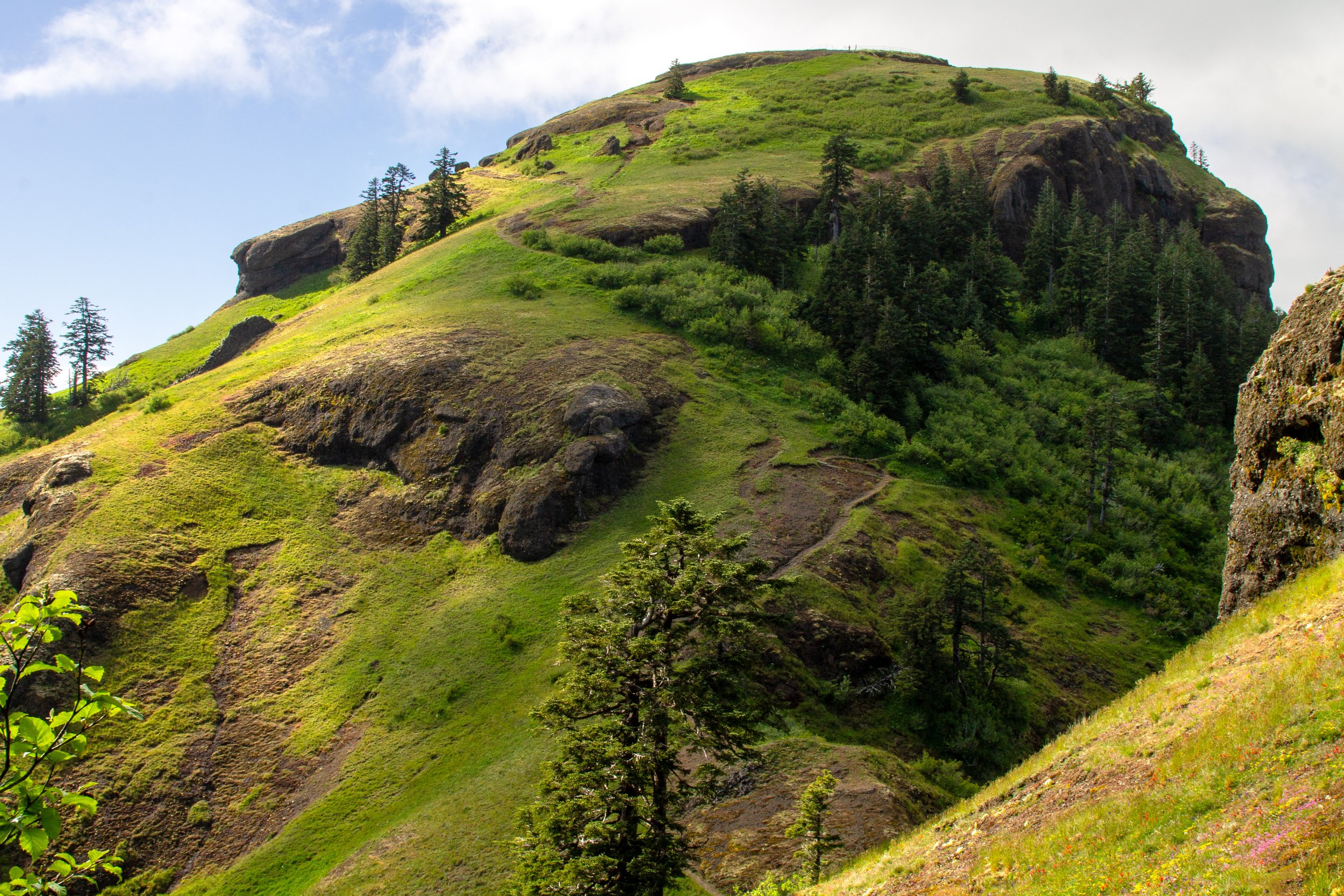
Trail to Saddle Mountain’s summit
Next, you walk across the dip in the saddle formation of Saddle Mountain before the final climb. The tree cover is minimal at this point, and you’ll have great views of the Coast Range to the south. What’s hard to capture in pictures is the scale of the scenery alongside the tiny wildflowers that cover the grassy slopes.
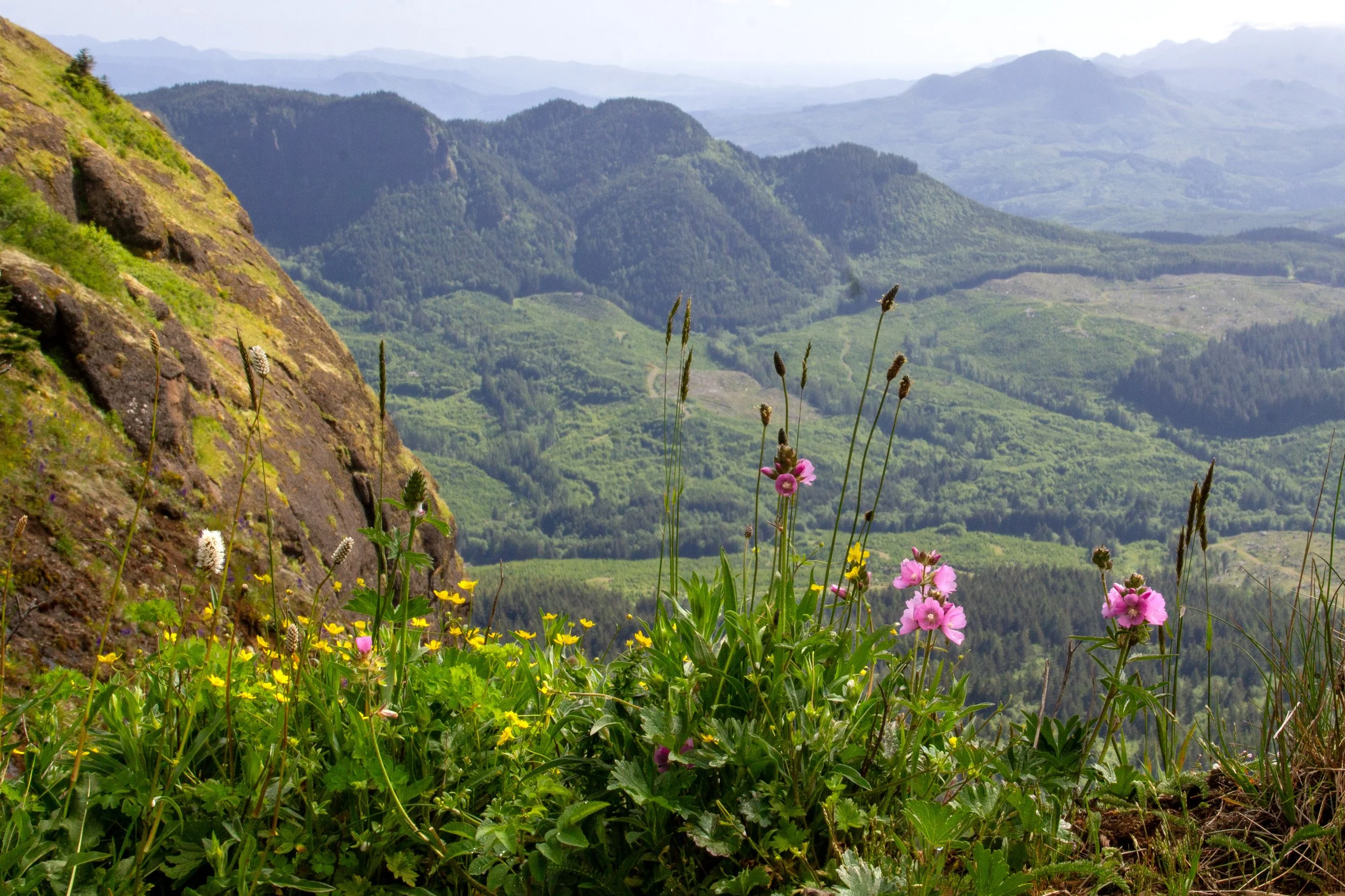
Saddle Mountain Trail
Now, the ugly part. At least in terms of terrain. The views are incredible, and keep getting better as you make the climb at the end of the Saddle Mountain Trail. The metal grating does a good job of keeping the rocks from rolling under your feet during the slow plod up the steep slope.
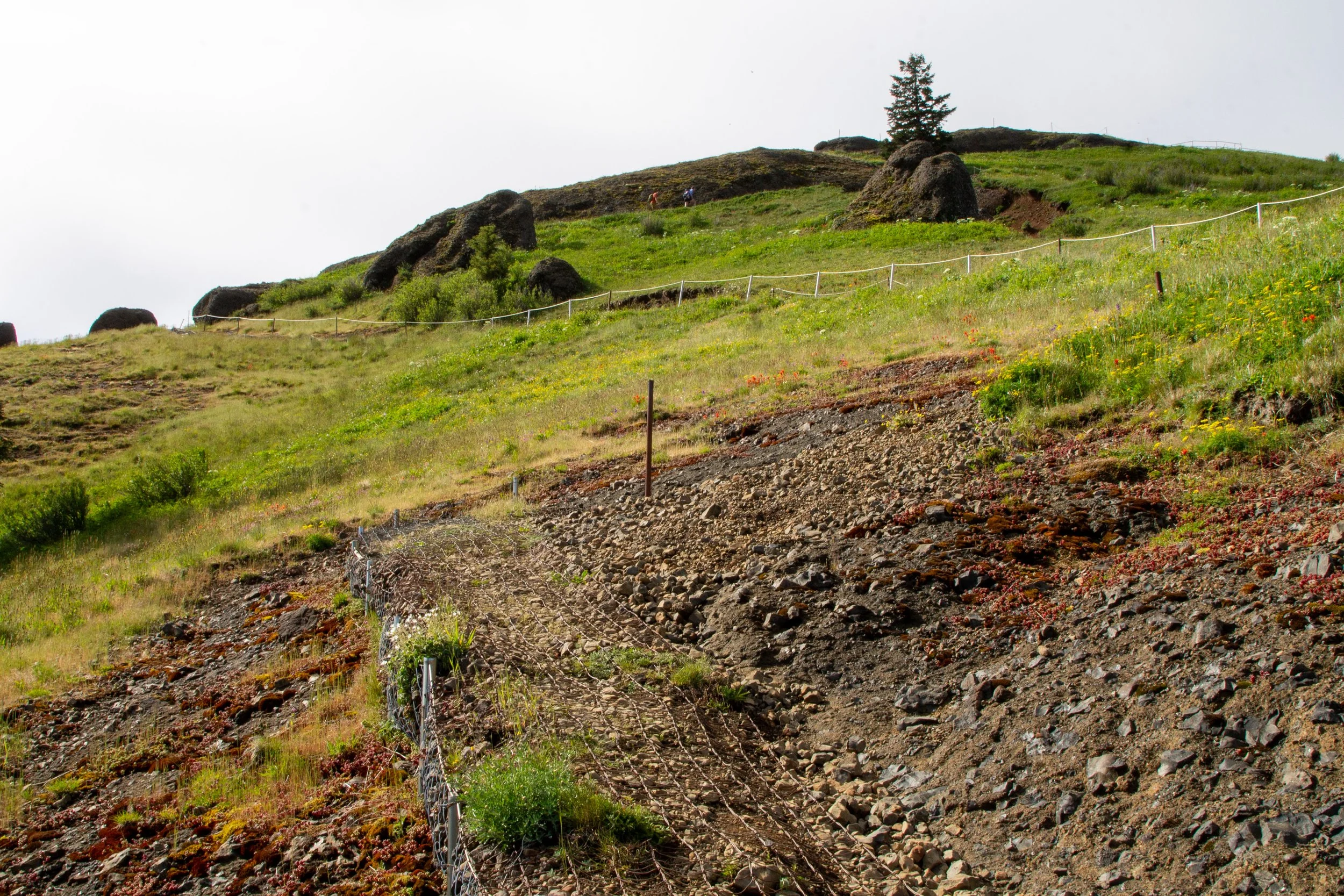
The hard part
Just before the summit, the trail divides. To the right is kinda sketchy trail out to a precipice with great views to the north. Not better, though, than those of the safer viewpoint at the summit.
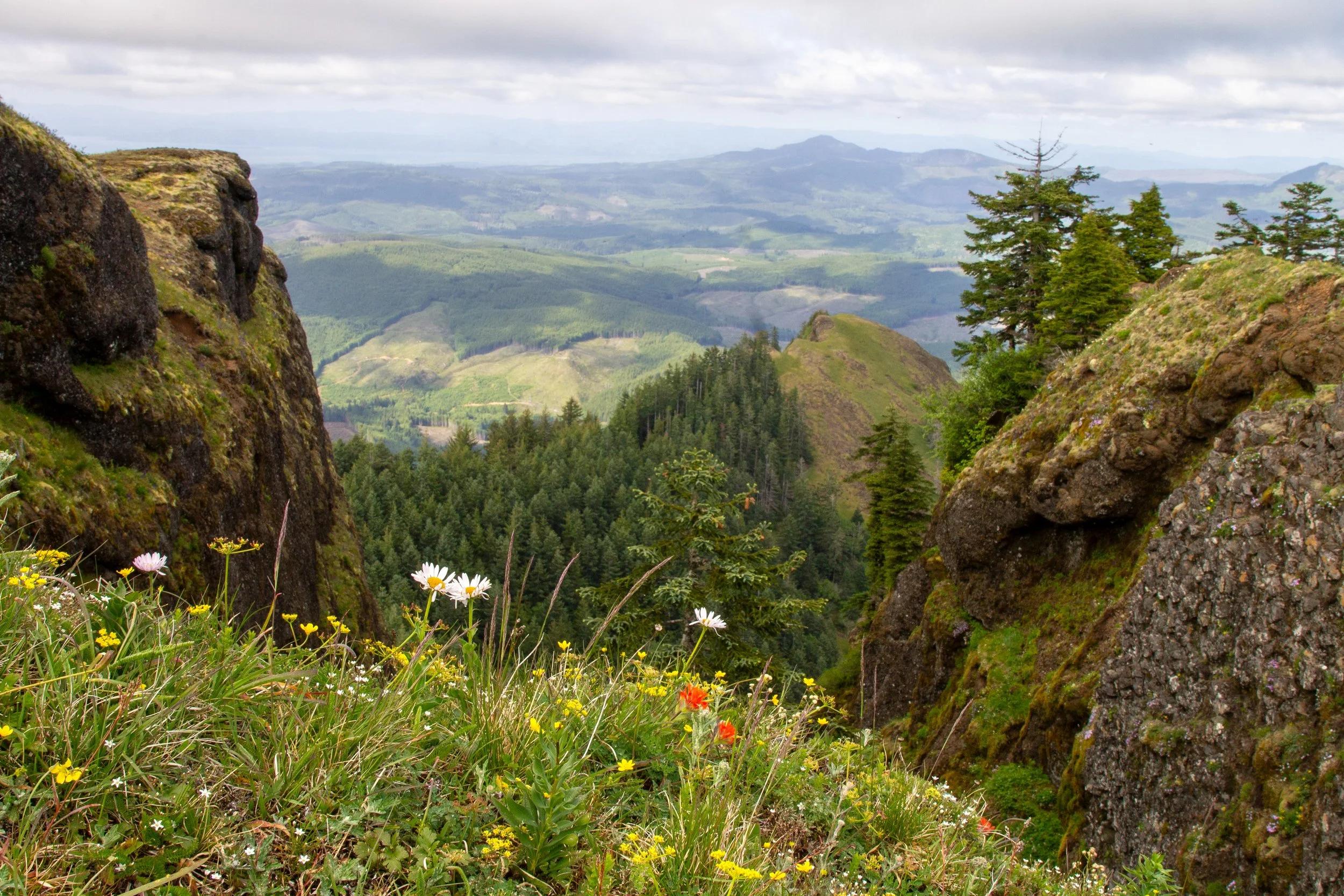
Trail divide near the summit
Saddle Mountain’s summit has a fenced, flat area with a picnic table and a diamond-shaped bench. It was once a fire lookout. I chose a day when multiple weather reports predicted full sun and perfect visibility, so naturally, it was hazy with many clouds.
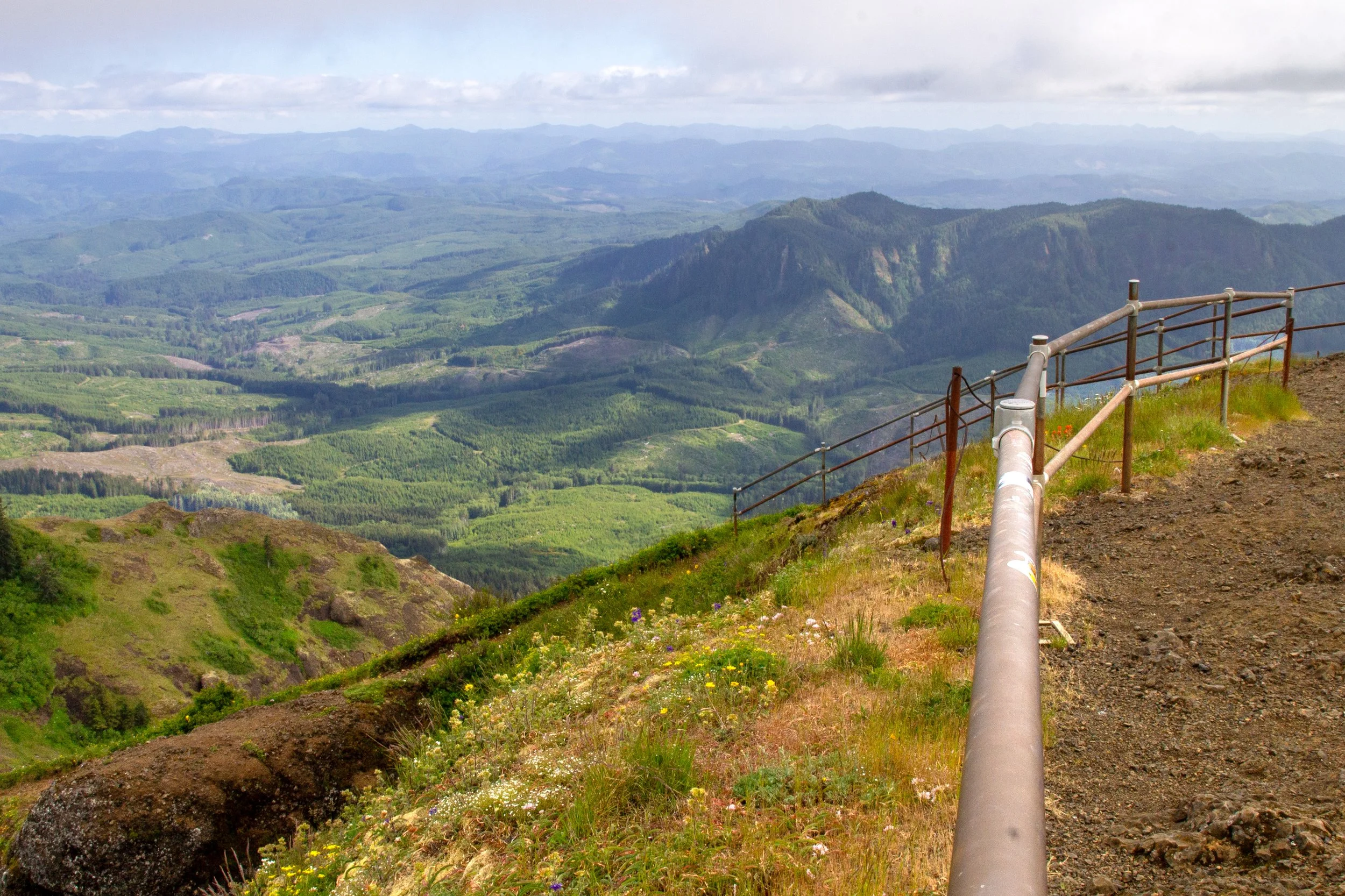
Summit viewpoint
Even with so-so visibility, the views are fantastic. You can see 360 degrees from 3,267 feet of elevation. To the west is the Pacific Ocean, Tillamook Head, Astoria, and the outlet of the Columbia River. On clear days, look for Mount St Helens, Mount Adams, and Mount Rainier to the north. To the south are the lumpy peaks of the Coast Range. To the east, the dip and rise that makes Saddle Mountain look saddle-like and, if it’s clear, Mount Hood and Mount Jefferson.
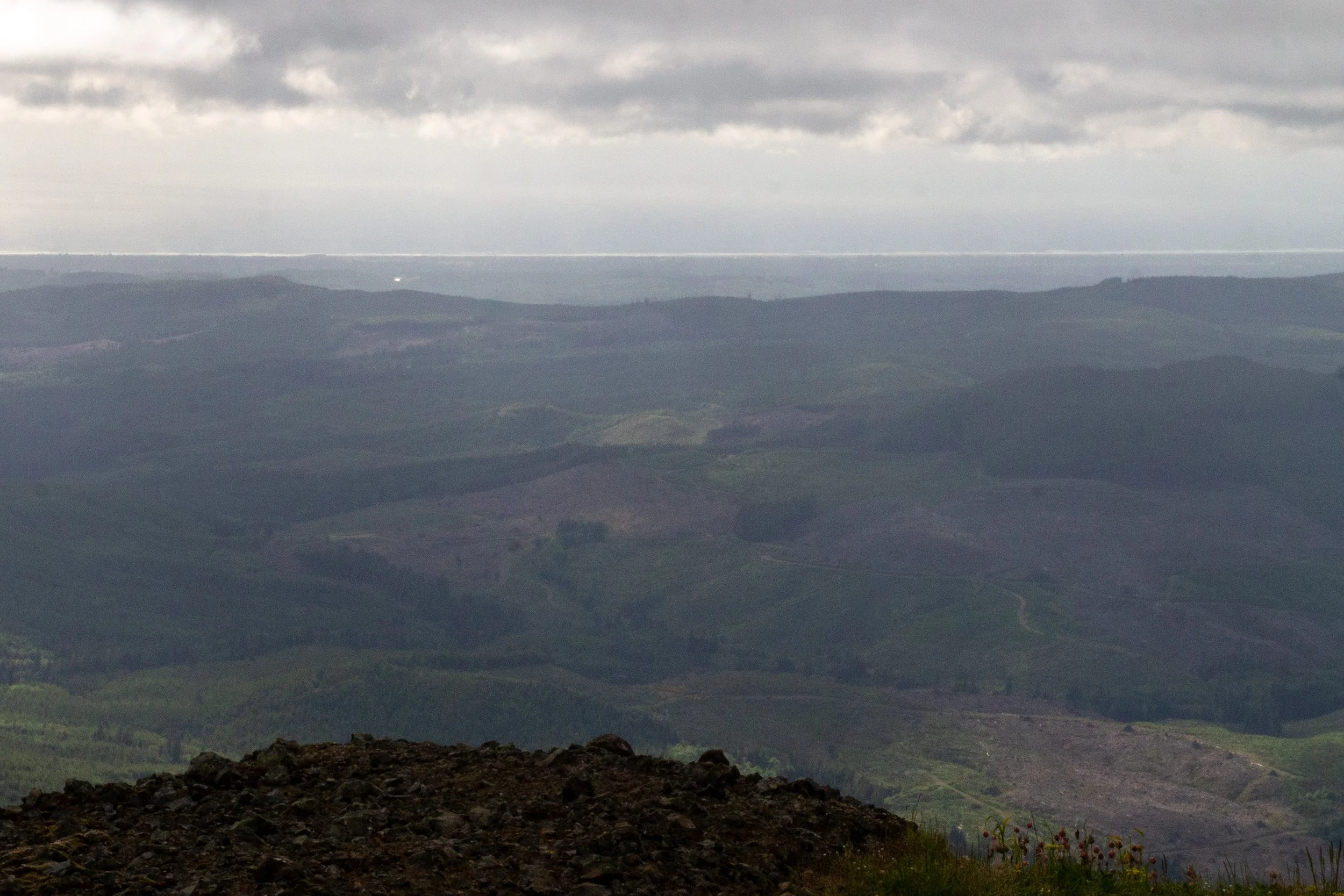
Ocean view
The unique climate that allows rare plants to thrive on Saddle Mountain also means that the weather can change quickly. While I sat at the summit, a thick fog rolled in for a few minutes, then dissipated just as fast. The temperature dropped about 20 degrees between the final climb and the summit. Bring layers, and don’t trust the weather report.
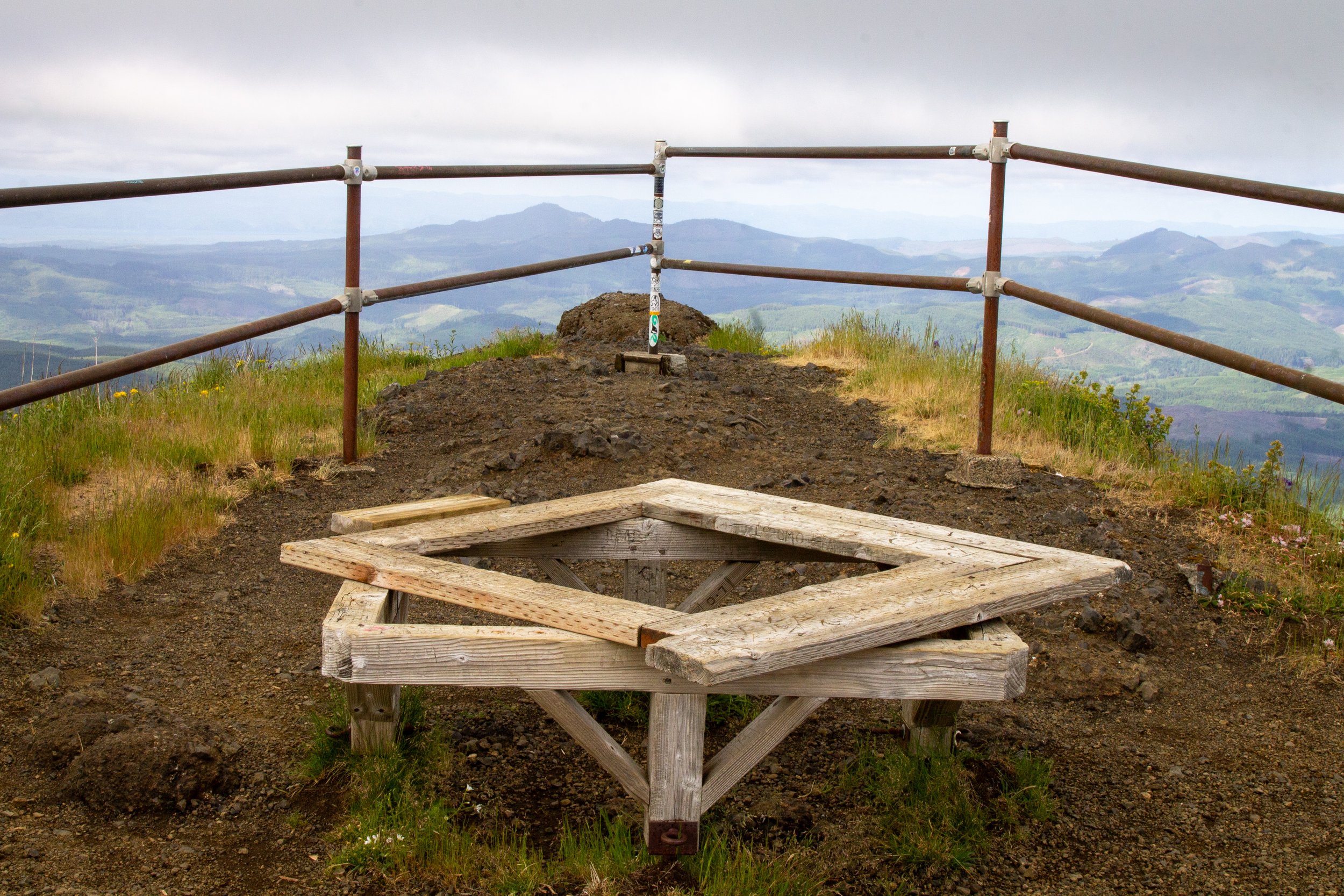
Saddle Mountain summit
After spending time on the top of Saddle Mountain, head back the way you came. It goes a lot faster on the way down. Allow about 4 hours total to complete the hike.
Getting there
To reach the Saddle Mountain Trailhead from Portland, take US-26 W until Jubilee Rd, then make a sharp right. Just before the turn is a sign for Saddle Mountain State Natural Area. Jubilee Rd becomes Saddle Mountain Rd just after the turn. Continue for 7 miles until you reach the parking area at the end of the road. It’s paved, with rough patches and potholes. It’s doable with a low-clearance vehicle, but I wouldn’t bring an RV. The drive from Portland takes about 90 minutes. From Seaside or Cannon Beach, 35 minutes.
Enjoy your hike at Saddle Mountain!
With love,
Emma
Explore nearby

Spend the perfect day in Cannon Beach, Oregon.
Spend a perfect day in Seaside, Oregon.
Check out the best hikes on the Oregon Coast.